Ref CR 03 · Craft Space art digital painting techniques
Technique Edition of 20/08/2026 also filed under: lighting, surfaces, compositing
Emissive material: a surface that produces its own light rather than reflecting someone else's, which changes how it is painted at every step, from its shadows to the colour of the rocks beside it.
In short
- Build a surface at three scales: silhouette, form, detail. In that order.
- A self lit surface tints everything near it and dies fast with distance.
- Hotter means bluer: red, orange, yellow, white, blue white, in that order.
1. Three scales of a surface
Any terrain, whether a lava field, a crater floor or a hull, is built at three scales. The silhouette is what reads from across the room: the big shapes and the spaces between them. The form is how those shapes turn in the light: the planes, the ridges, the way a slope faces the sun or away from it. The detail is texture, and it comes last and least.
Work in that order and detail becomes decoration on a structure that already works. Work in the reverse order and you get a beautifully textured shape that reads as nothing from two metres away. If a painting looks busy but weak, the fault is almost always that scale three arrived before scale one was settled.
2. Emissive materials
Lava, plasma, a glowing panel and a star all behave the same way in a painting. Four behaviours to reproduce:
- It has no shadow side. An emitting surface is lit by itself, so it stays bright where a reflective surface would go dark.
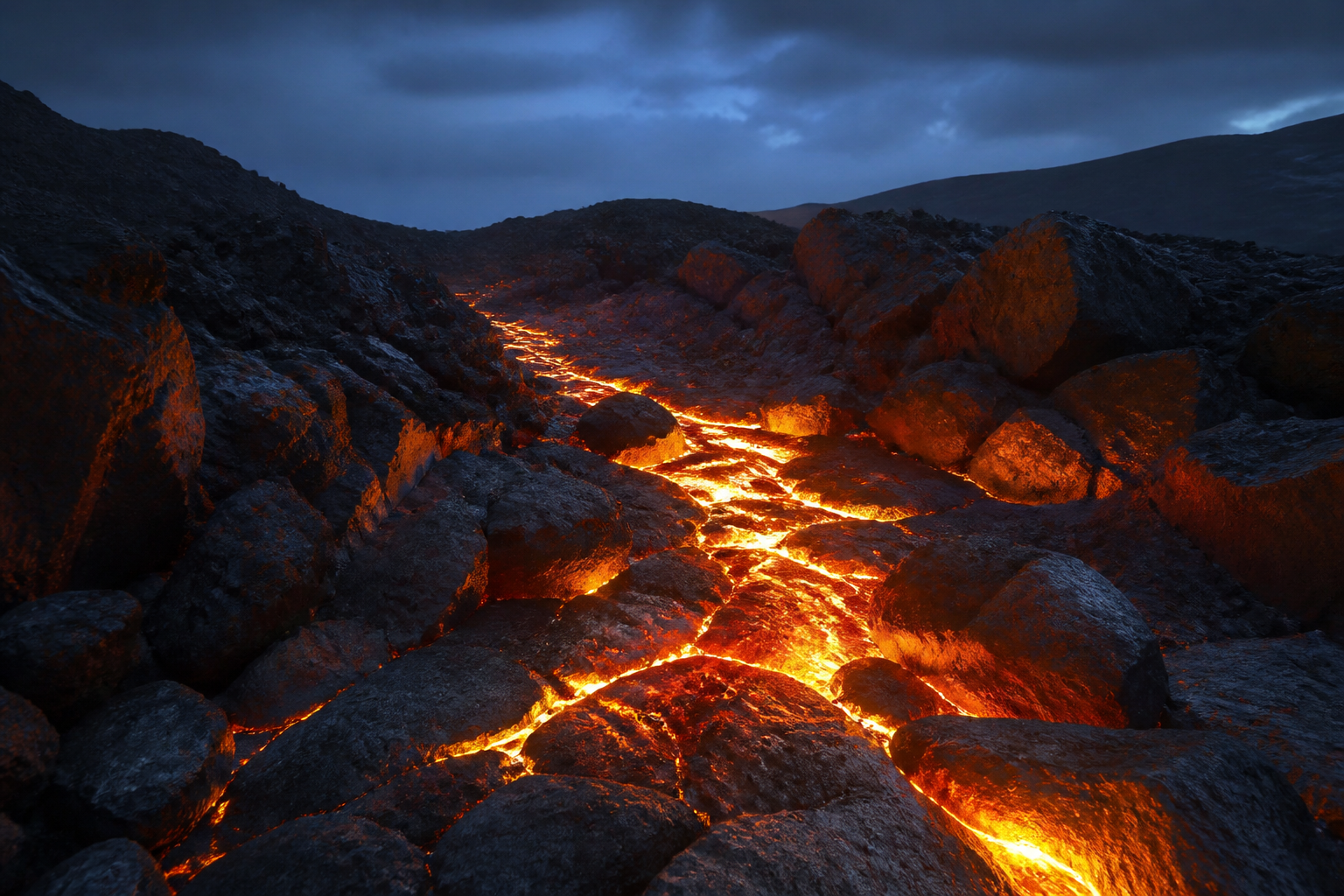
- It fills nearby shadows. Rock next to a lava channel has no black shadows: they are filled with orange bounce. This is the single most convincing detail in a lava scene.
- It blows out at the core. The hottest part reads as white, not as saturated colour, with the saturation living in the ring around it.
- It carries a cool rim. When a cool source lights the scene as well, the emissive form keeps a thin cold edge where the two meet, which is what stops the picture becoming one orange soup.
3. Falloff
Light from a small nearby source falls off with the square of the distance: double the distance and the surface receives about a quarter of the light. That is why a lava crack lights the rock at its edges violently and the wall three metres back barely at all.
Light from a very distant source behaves differently in practice. The Sun obeys the same law, but over the scale of a scene the change in distance is negligible, so illumination is effectively even across the frame. Painting a sunlit scene with a visible falloff is a common error, and painting a lava scene without one is the same error in reverse.
| Source | Shadow edge | Falloff across the scene | Colour behaviour |
|---|---|---|---|
| Distant sun | Nearly hard, small soft border | Negligible: even across the frame | One consistent hue, unfiltered in vacuum |
| Nearby emissive pool | Soft, and softer with distance | Strong: roughly inverse square | Spills colour on everything close to it |
| Glowing panel or window | Soft, shaped by the opening | Strong near, weak beyond | Takes the colour of the panel, not of the sun |
| Sky dome with atmosphere | Very soft, almost none | Even | Tints the shadow side toward the sky colour |
| Reflected light from a planet | Very soft | Even at scene scale | Carries the planet's colour into the night side |
Wide table: scroll it sideways.
4. Colour by temperature

Hot things glow in a predictable order. As temperature rises, the colour of a glowing body runs red, then orange, then yellow, then white, then blue white. This is why a piece of heated iron passes through those colours, and why star colour maps onto spectral class in exactly the same order.
The practical use in a painting: keep a single ramp for each emissive material and stay on it. A lava flow that runs from deep red in the crust cracks, through orange, to a near white core reads as one temperature gradient. A lava flow with a green highlight reads as a lighting mistake, even to a viewer who has never thought about temperature.
5. Atmosphere or none
Decide early whether the scene has air, because it changes the whole depth strategy.
- With atmosphere: distant features lose contrast and shift toward the colour of the sky. Dust in the air catches light beams. Shadow edges soften with distance from the object casting them.
- Without atmosphere: contrast holds all the way to the horizon, the sky stays black in daylight, shadows stay hard and dark, and depth has to come from overlap, scale and the sharpness of the terminator instead.
A moon painted with haze looks wrong for a reason the viewer cannot articulate. A hazy valley on a world with a stated thick atmosphere looks right for the same reason.
6. Working in passes
Borrow the discipline from three dimensional rendering and keep each contribution on its own layer group: local colour, occlusion, key light, bounce and fill, emissive, atmosphere, then grade. The advantage is not tidiness. It is that a change of mind about the key light does not touch the texture, and a change of mood at the end is a curve on a group rather than a repaint.
Two rules keep the stack usable: name every group, and flatten nothing until delivery. If the file becomes unmanageable, flatten a copy and keep painting on that, but archive the layered master.